
Long Branch Resident Lookup Coverage
To look up a resident in Long Branch, match the record to the question. A property entry can identify an owner of record or a mailing recipient. A court result can identify a party in a case. A voter result concerns registration status. A vital record can document an event or relationship. Each is useful, but none creates a complete list of people who live in the city. Keep the role and record date beside every result.
| Record source | Question it can answer | Long Branch or state route | Access path |
|---|---|---|---|
| Assessment and tax record | Owner of record, mailing address, location, and parcel context | Long Branch Tax Assessor and Monmouth OPRS | Municipal office and electronic assessment route |
| Court case index | Party name, venue, docket, case caption, and initiation date | New Jersey Courts public search | Public case search, then the relevant court custodian |
| Voter registration | Registration-status context under election rules | New Jersey voter registration check | Official lookup or Monmouth election offices |
| Vital record | Documented birth, death, marriage, partnership, or civil-union event | Long Branch Vital Statistics or NJ Department of Health | Restricted copies through the proper registrar |
| Business, notary, or license record | Public organizational, commission, or credential role | New Jersey revenue and licensing records | State search or public-record request |
Start with the source tied to the known fact. A known parcel calls for the assessor and OPRS. A known case calls for the court system that heard it. A family-history question usually starts with date ranges, local directories, and the appropriate vital or probate channel.
Set a Long Branch Lookup Question
Write down the full name, alternate spellings, middle initial, approximate age or birth year, relationship, likely period, and any Long Branch street or ZIP already known. New Jersey voter instructions specifically warn that spaces, hyphens, middle initials, punctuation, and nicknames can affect a search. Do not join two similar names just because they share a city reference.
For a historical relative, use the date of the claim to choose the source. Long Branch library directories, yearbooks, newspapers, maps, and photographs can provide time-bound context. Monmouth Archives and the Surrogate can add older marriage, estate, or probate evidence. A present-day index should not be used to erase a gap in an older record trail.
Note: Preserve the exact search spelling, jurisdiction, date range, result count, and retrieval date so another search can be repeated accurately.
Search Long Branch Court Records
Long Branch matters may sit in different systems. Municipal Court covers the local matters listed by the city, Monmouth Superior Court belongs to the Monmouth Vicinage, and a federal matter goes to PACER. Searching only one of those routes cannot show that no record exists. Use Long Branch Municipal Court for its local procedure and the statewide public search for the case categories it publishes.
The New Jersey public case-jacket model supports searches by docket number, party name, and judgment. Party searching distinguishes an individual from a business and uses last name, first name, and an optional middle initial. Very short strings behave more exactly, while three or more characters broaden matching. Try defensible variants and retain the venue before treating a name hit as relevant.
The Long Branch Court Forms and Resources page is the source for the Judiciary Records Request route and related court materials.
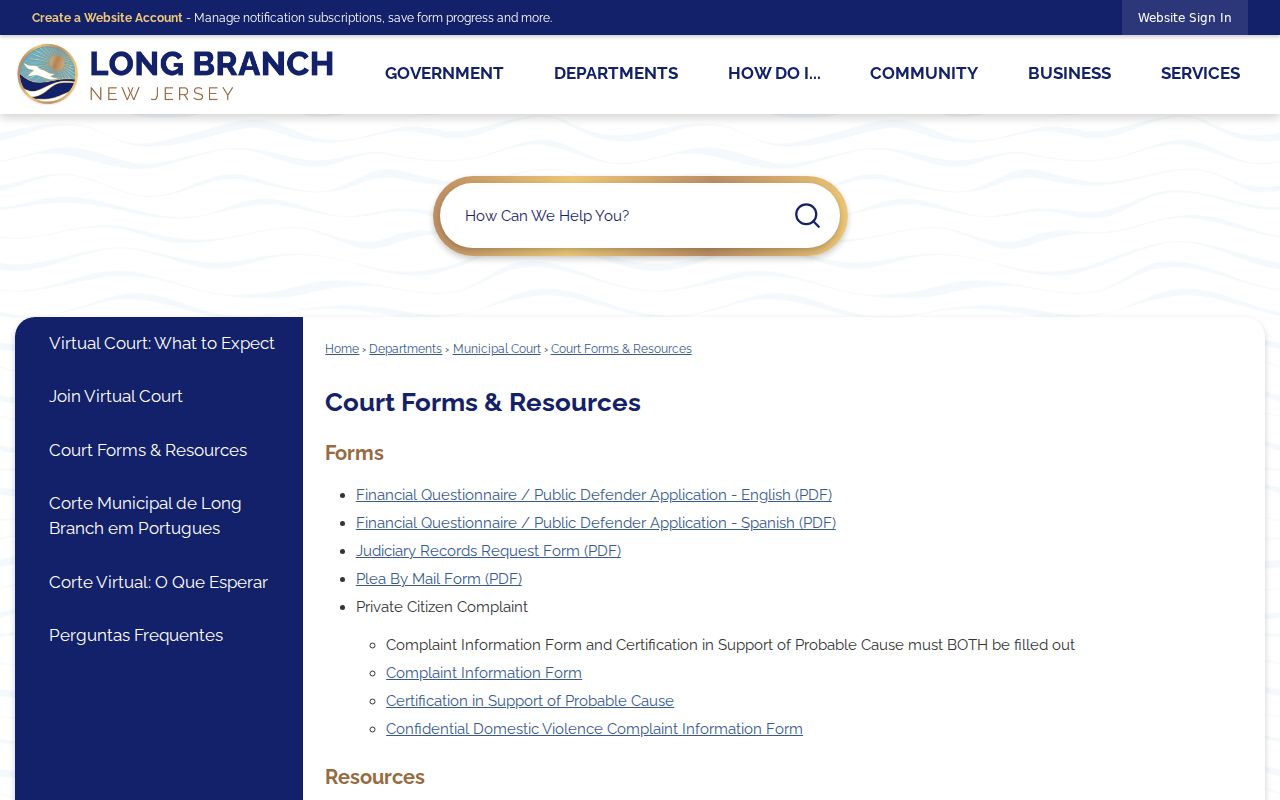
A records request is distinct from discovery or a police-held incident file, so name the desired docket, disposition, complaint, or other record product when contacting the custodian.
For a municipal disposition copy, the city FAQ lists a $10 copy with a raised seal and a $5 copy without one. Discovery follows a separate path: the FAQ directs a written letter to the court for a stamp before it goes to Police Records. Accident reports are routed to Long Branch Police Records at 732-222-1000 ext. 1800, not to the public case search.
The Long Branch Municipal Court page shows the local court route and its forms.
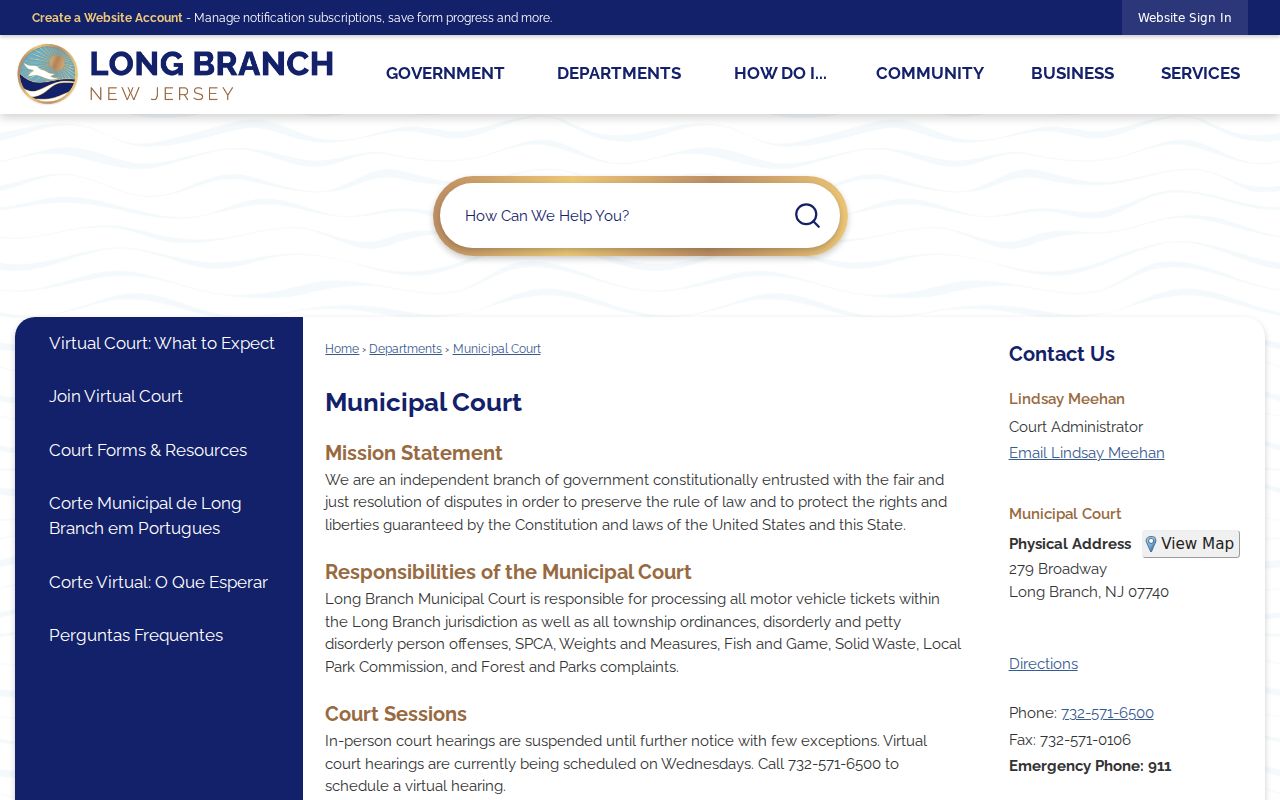
When a court result is incomplete, request the smallest record that answers the question and label any sealed, expunged, juvenile, or confidential restriction rather than guessing why a result is absent.
| Public case-result field | What to retain |
|---|---|
| Name | Exact spelling and whether the listed party is an individual or business |
| Venue | The court location or jurisdiction connected to the result |
| Docket number | The case identifier used to open the case jacket or request a record |
| Case caption and initiation date | The matter label and the date the case began, plus any displayed status or disposition |
Verify a Long Branch Resident Lookup
A careful resident lookup uses at least two independent sources. A tax card and a deed can repeat the same property relationship, so pair them with a different type of evidence when identity is uncertain. For example, a dated directory entry and a newspaper event can support an older address, while a probate record and a recorded deed can establish separate roles in an estate or transfer.
- Anchor the name to a date and source type. If an address is known, compare the Long Branch assessor record, OPRS tax entry, and parcel identifier without calling the owner a current occupant.
- Run the appropriate court party search with the exact spelling and plausible variants. Save the venue, docket number, case caption, and initiation date.
- Check the historical or vital route that fits the event date. Keep relationship evidence separate from address evidence.
- Ask the record custodian for a certified copy only when an official certified document is needed, and preserve the source and retrieval dates for every result.
- Docket
- A court’s identifying number for one case. It ties searches, case-jacket entries, and record requests to the same matter.
- Index
- A finding list of records or fields. An index result can point to a document, but it is not necessarily the document image or the full filed text.
- Certified copy
- A copy issued by the responsible custodian with the certification required for that product. An OPRS image is an informational digital reproduction, not a sealed certified copy.
Use Long Branch Vital Records by Date
For a Long Branch event, begin with the local registrar. The Health Department supports mail and in-person requests and lists birth, death, marriage, domestic-partnership, and civil-union certificates at $15 each. The local process requires full record identification, the required identification, a qualifying relationship or authorization, and payment by check or money order. The city does not publish a precise turnaround on the reviewed page.
Newer state records are not an open online directory. The New Jersey Department of Health provides online, telephone, walk-in, and mail channels, while the State Archives holds older material. Genealogy requests follow a different form and date rule: a birth must be more than 80 years old, a marriage more than 50 years old, and a death more than 40 years old. A certified copy has stricter relationship and identification rules.
The state non-genealogical request guidance shows the identity, relationship, event, and payment details a complete request needs.
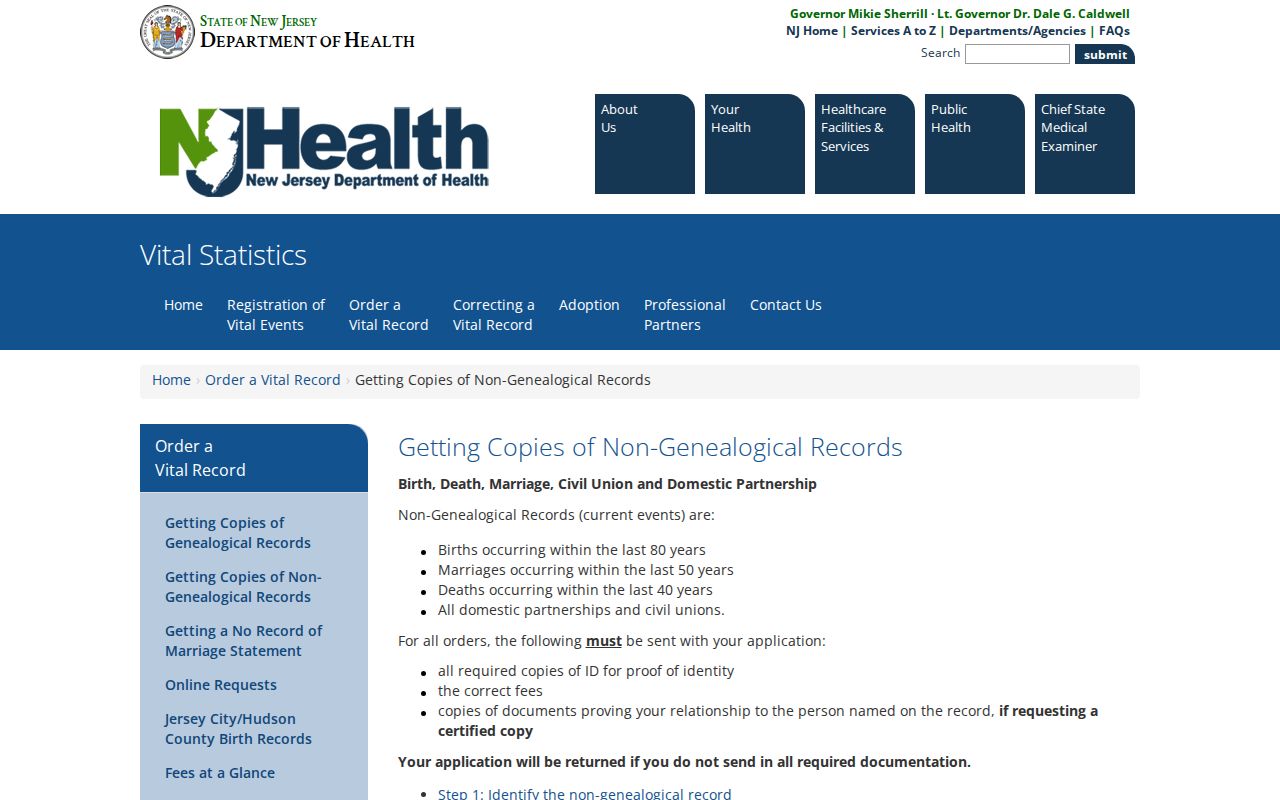
A vital certificate documents an event or relationship. It does not, by itself, establish a present address, and adoption-related routes have their own limited eligibility and contact-preference rules.
Check Long Branch Voter Records
The official voter registration check asks for first name, optional middle initial, last name, and date of birth. Its result should be read as voter-record context, with the search date and jurisdiction recorded. The state’s live result columns were not captured during research, so do not promise a field that the public screen does not display.
Monmouth County divides duties among the Commissioner of Registration, Board of Elections, and County Clerk. A certified voter list has a statutory scope that includes name, address, date of birth, party affiliation, and voting history, while signatures are excluded unless a court orders otherwise. It is not a general resident roster. An inactive record, a different name format, or a confidentiality program can also explain a missing result.
The New Jersey voter registration service outlines the official registration and election channels.
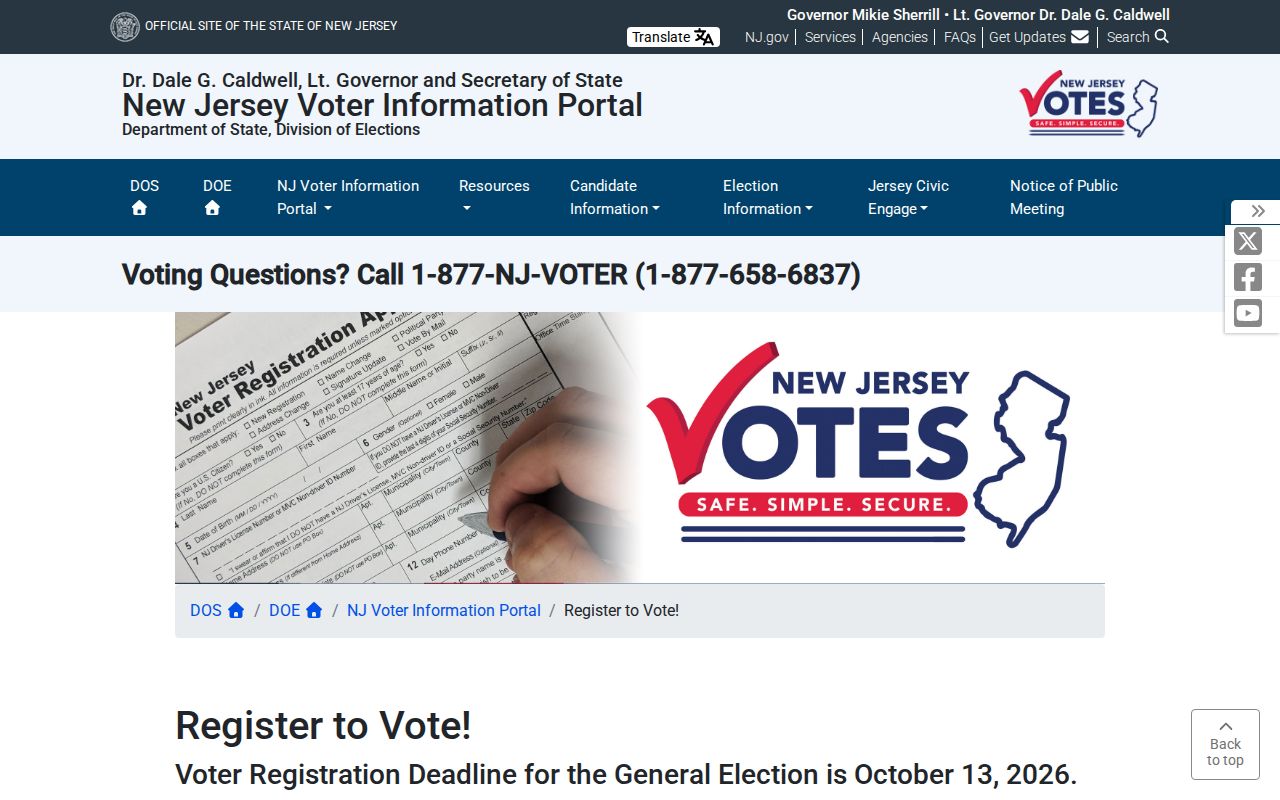
Use voter information for the limited civic-record question it answers, then corroborate identity and date with a source that records a different relationship.
MYTH: A Name Record Proves Residence
A deed, tax card, voter result, court record, business filing, license entry, or historical directory listing can be a strong lead. It does not automatically prove that a person currently resides at that location. The record may identify a grantor, grantee, owner, mailing recipient, applicant, court party, business manager, commission holder, or past occupant. State the role and date instead of replacing them with a broader conclusion.
This is especially important in Long Branch, where a property record can show a mailing address that differs from the parcel and where older coastal directories can include hotel, seasonal, business, or regional entries. A two-source evidence chain should use genuinely different categories, not two screens that repeat the same underlying property information.
Note: A precise role label and date make a negative result or a partial match more useful than an unsupported current-residence claim.
Verify Long Branch License Records
When the question is whether a claimed organization or credential is real, use the state record that created it. The New Jersey Division of Revenue business-name search treats exact spelling, spacing, and punctuation as meaningful. A public status report may identify a registered agent, business address, filing dates, annual-report details, officers, managers, and legal status. Those are organizational facts, not private-address evidence.
New Jersey’s notary search uses last name, city, ZIP Code, or commission ID and shows active commissions and validity dates. The real-estate license search accepts an individual or company name, partial name, reference number, license type, and status. Both are role-verification tools. They do not show that a notary handled a particular document or that a license holder resides at a given address.
The Division of Revenue business search is the official starting point for an entity-name question.
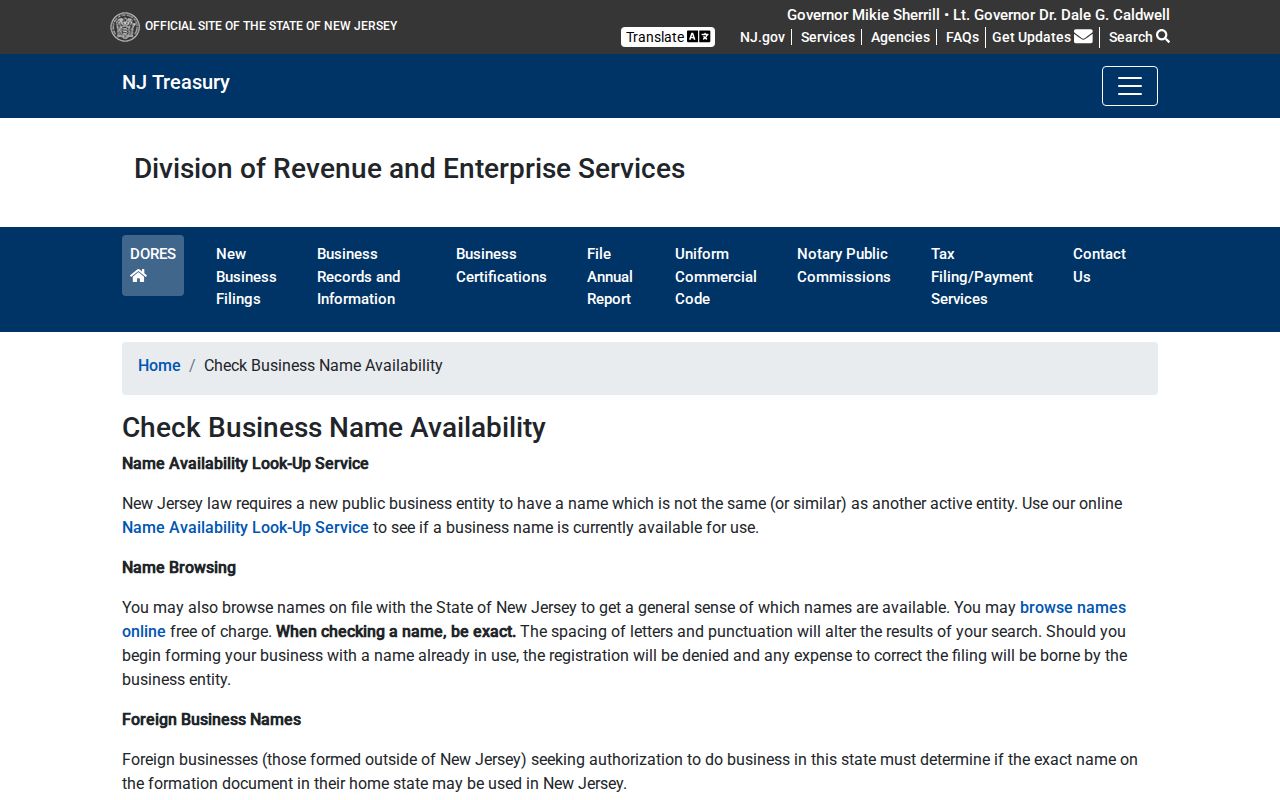
Compare the legal name, entity type, status, source date, and the specific claim being checked before treating a similar name as the same person or organization.
Long Branch Resident Lookup Limits
New Jersey’s Address Confidentiality Program provides eligible participants a substitute address for future government-record use. Daniel’s Law supports redaction of home addresses and unpublished phone numbers for covered judges, prosecutors, law-enforcement personnel, and their immediate household family members. A missing or redacted address should never be reconstructed from unrelated records. Follow the official notice or removal route when protected information appears.
Court files can be sealed, expunged, juvenile, confidential, or otherwise restricted. Vital records require the right request type, relationship proof, identification, and payment. If a public record is incomplete, ask the creator or custodian for the smallest available record or submit a focused request under the New Jersey Open Public Records Act. County guidance does not move court or vital records into the county office; each remains with its proper custodian.
Long Branch courts, Long Branch Vital Statistics, Long Branch property records, Long Branch voter results, and Long Branch library collections have distinct custodians and date ranges. A Long Branch result from one channel must not fill a gap in another. Keeping that Long Branch provenance makes a later check repeatable.
Lawful use. Use a Long Branch resident lookup for personal, lawful research such as family history, heir work, civic records, or checking a claimed public role. Do not use record details to stalk, harass, intimidate, or harm anyone.